
What is Phishing in Cyber Security?
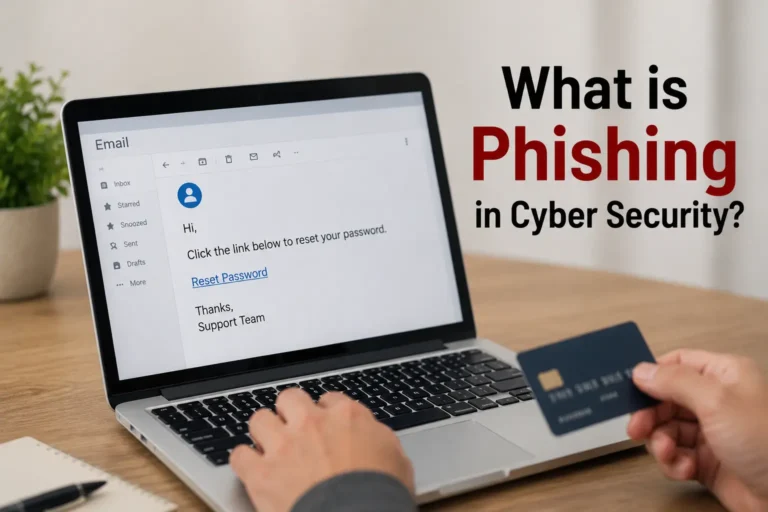
A cybersecurity phishing attack is among the most widespread and misleading cases in the online space, which operate not based on technical imperfections but through human trust. It is defined as fraudulent activities in which the offenders disguise themselves as legitimate persons to deceive people to disclose sensitive information like passwords, bank details, or access credentials.
The most dangerous feature of phishing is that it can become undistinguished in daily communication, emails and messages, websites and even phone calls can be used as weapons. With the further increase in our dependence on digital platforms, Dualsys techno recognizes that phishing attacks have become more sophisticated, large-scale, and influential. The first step to defining phishing as it is will be the fundamentals of how to identify the danger as well as how to protect against an attack that is aimed at people and not technology.
Introduction to Phishing in the Digital Era
In cyber security, phishing is a form of deceptive social engineering where cybercriminals masquerade as individuals they are supposed to be trusted by, to lure them to give sensitive information. Instead of using software weaknesses, phishing attacks rely on human reasoning by writing messages that seem valid, urgent or known.
The attacks are usually done using emails, text messages, telephone calls, or even false websites in the name of well-established organizations like banks, service providers, work places etc. It is typically aimed at stealing logins, financial information or personal information, or providing malicious links and attachments with the aim of breaking systems.
Due to its simplicity and scalability, as well as efficiency, phishing is regarded as one of the most dangerous cyber threats. With the development of digital communication, phishing also evolves, so there is a strong necessity of understanding what it is and what dangers it can raise before delving into the more specifics of the matter.
How Phishing Attack Works in Cyber Security: Step-by-Step Explanation
The phishing attacks are based on a calculated procedure which is well planned to attack human behavior and not technology. An insight into every step will expose the way attackers gain trust, control behavior and eventually steal sensitive data.
- Target Research and Preparation
A phishing attack may start with the attackers collecting the details of their targets. It can consist of names, email address, job description or latest actions. This is aimed at creating relevant, familiar, and credible messages that are acceptable to the recipient. - Developing a Deceptive Message or Identity
Attackers structure emails, messages, or calls that would mimic known organizations or individuals. They meticulously replicate logos, writing styles, and forms, in order to seem legitimate, and usually add a sense of urgency or authority to compel victims to act without thinking. - Delivery using ordinary communication channels
The message that has been designed is sent through e-mail, SMS, social networks, or phone calls. The channels are selected as individuals engage with them on a daily basis and hardly ever doubt the customary communication, and thus phishing efforts can easily be masqueraded as regular online communication. - Triggering Action through manipulation
The message makes the victim click on a link, attachments or give out sensitive information. Caution is bypassed in favor of immediate action by psychological stimuli such as fear, curiosity, or urgentness. - Information Theft or system compromise
After the victim communicates the malware captures their credentials or personal data using fake websites. The stolen information is then used to commit financial fraud, identity theft, or additional cyber attack often without immediate notice.
Modern Phishing Techniques Targeting Cloud and Mobile Users
Phishing now targets cloud platforms and mobile users more than ever before, with convenience being the most common concern over caution. Attackers now mimic trusted cloud services such as email services, file sharing tools and collaboration systems and use a spoofed login page to steal credentials and get around multi-factor authentication by session hijacking.
Smaller screens, shorter URLs, and notification through apps are some of the phishing benefits on mobile devices because malicious links are more difficult to identify. Mobile phishing through QR codes and counterfeit security warnings have increased remarkably as well. With an increasing dependency of businesses on cloud and mobile technologies, such attacks have been dangerous to the integrity and access control of data.
At Dualsys techno, these changing threats, as managed by awareness, secure cloud practices, and proactive cybersecurity solutions, is a major issue that requires attention by contemporary organizations.
5 Types of Phishing Attacks in Cyber Security
Phishing attacks exist in various forms, yet some major ones cover the majority of the real-life cases. The knowledge of these fundamental approaches simplifies the identification and prevention of possible threats.
- Email Phishing
The most prevalent form of the attackers send spoof emails impersonating trusted organizations. These messages will typically have malicious links or attachments that will steal login credentials or sensitive information. - Spear Phishing
An attack directed to particular persons or organizations. The messages are very personalized with the actual names, roles, or activities to look legit and have a high possibility of being successful. - Whaling Attacks
An advanced type of spear phishing that is aimed at senior executives and decision-makers. Such attacks are usually accompanied by pressing financial or legal demands in order to have access to valuable information. - Smishing (SMS Phishing)
Phishing, which is effected in the form of text messages, mostly in the form of bogus delivery messages, security warnings or account alerts to entice users into clicking on malicious links. - Vishing (Voice Phishing)
Phishing through phone calls as attackers pose as banks, customer support or authorities to deceive victims to disclose confidential information.
These five categories are the most threatening phishing schemes in the current cyber world.
How to Identify a Phishing Attempt: Key Warning Signs
A basic cyber security skill is the ability to identify phishing operations because most phishing attacks follow the formula of users being unable to notice the warning signals present, even though they are subtle. Phishing texts tend to generate a feeling of urgency, which requests the recipients to respond instantly to prevent account leakage, loss of money or security concerns. There are warning signs of suspicious sender addresses, mismatched domain names, generic greetings, and uncharacteristic attachments or links.
The bogus sites can be similar to the legitimate ones, but most of them will have minor spelling errors or odd URLs. In the mobile devices, truncated links and ambiguous messages pose higher chances of deceit. Phishing calls can also compel the user to provide confidential information over the phone. Early identification of such red flags can avoid credential theft, data breaches, and unauthorized access, and therefore vigilance is an essential level of protection when interacting digitally on a daily basis.
Why Phishing Is So Successful: Human and Technical Reasons
Phishing is very effective since it employs a human mind and a technical loophole and not an elaborate hacking technique. Attackers exploit such emotions as urgency, fear, trust, and curiosity on the human side. The message that seems to be sent by a bank, an employer, or any other services with which the user is familiar leads to immediate responses, and the latter may overwhelm logic.
Time constraint, information overload and poor cybersecurity awareness also create an additional vulnerability which Dualsys techno is actively responding to with security-oriented solutions.
Technically, phishing works because of the flaws in email filtering, authentication, and user check-ups. The attackers employ spoofed domains, hijacked accounts and realistic replicas of websites to evade the defenses. With the increasing usage of the cloud and mobile systems, Dualsys techno suggests that to minimize the impact of phishing, it is necessary to integrate technology, awareness, and proactive security.
Role of AI and Automation in Advanced Phishing Attacks
Phishing attacks have evolved greatly by AI and automation which make them faster, intelligent and more difficult to detect. The attackers now apply AI to create very realistic messages that copy the language, tone, as well as context of the people, making it easy to overlook any red flags.
Phishing campaigns can be opened on a grand scale and remain personalized due to automation, raising the success rates. The analysis of leaked data, high-value target identification, and the optimal timing and messaging are also done by machine learning. Moreover, AI-based tools assist attackers to produce believable fake websites and deepfake voice calls, as well as adaptive phishing content, which adjusts itself depending on user behaviors. This development has changed phishing into a targeted attack rather than a generic scam, which has escalated the necessity of sophisticated security awareness and sophisticated defense.
Cybersecurity refers to the practice of protecting systems, networks, and data from digital attacks and unauthorized access, helping individuals and organizations stay safe online.
Read more about Cyber Security: What is Cyber Security?
Impact of Phishing on Businesses and Individuals
The implications of phishing are extensive, both to organizations and the individuals involved and can be long term in nature. In the case of businesses, phishing attacks may lead to loss of data, money, operational setbacks and damage to reputation. Intruded credentials can give attackers access to internal systems, customer data or cloud resources, which can result in compliance violations and mistrust conditions, which Dualsys techno is striving to eliminate by good cybersecurity practices.
To users, phishing may result in identity theft, unauthorized purchases as well as severe privacy infringement. The psychological and financial burden of healing after such attacks may be huge. Phishing is ever-changing, and that is why Dualsys techno stresses on the need to be more aware, more proactive in security, and more resilient in the digital economy to protect businesses and people.
Phishing Prevention Strategies By Dualsys techno: Beyond Basic Awareness
In the case of Dualsys techno, phishing prevention is not a simple user awareness or reactive security response, but it is an all-inclusive proactive defense mechanism that is adapted to the contemporary digital context. Dualsys techno combines the use of advanced threat intelligence, behavior-based detection, and cloud-first security designs to detect phishing attacks prior to reaching users or devices. We concentrate on identity protection, communication channel protection, and are constantly monitoring threats to email platforms, cloud-based platforms, and mobile access points.
The difference between Dualsys techno and other firms is its active defense and business continuity. Our approach also enables organizations to minimize the surface of attack, enhance authentication systems, and resilience to emerging and AI-based phishing risks.
Rather than analog defense systems, companies find a security provider that keeps pace with the threat environment. In case your organization is willing to go beyond awareness and do something serious with phishing, Dualsys techno will provide the knowledge, creativity, and trust to protect your online future.
Ready to Stay One Step Ahead of Phishing Threats?
Phishing attacks are more precise than ever, reaching people, cloud as well as mobile environments. It is no longer possible to rely on awareness alone. A security strategy that is designed to meet the requirements of the modern threat environment is what you require to ensure you are indeed protecting your business, data, and users. Dualsys techno is the organization that empowers its clients with active, intelligent phishing protection solutions that do not rely on basic protection, but rather a combination of intelligence, innovativeness and constant monitoring.
It is not necessary to wait and get attacked to determine vulnerabilities. Put your cybersecurity position into your hands with a partner that is knowledgeable about the human and technical aspects of phishing. Brand phishing prevention into a solid business strength of your digital future. Contact Dualsys techno and make phishing prevention a strong asset to your organization today.
Conclusion
The reason why phishing continues to be the most common cyber threat is the fact that it appeals to human instincts, and it silently encompasses technical vulnerabilities. Phishing attacks have become more complex as discussed in this blog, as criminals have developed multichannel tactics that are targeting cloud systems, mobile users, individuals, and organizations.
Automation and AI usage have also gained momentum, which makes them larger and more effective and requires their timely identification and well-informed action. The most important step in minimizing the risk of phishing is understanding its operation, the types it takes and determinants that make it successful. Cyber resilience in the long term is based on informed awareness and robust security practices in a highly digitized world.
FAQs
Phishing is a type of attack which attempts to steal your money, or identity by making you disclose personal information, such as credit card numbers, bank identities, or passwords, on websites that appear to be legitimate.
The four common types of phishing attacks are Email Phishing (mass emails), Spear Phishing (targeted individual attacks), Smishing (SMS/text message scams), and Vishing (voice/phone call scams)
The “4 Ps of Phishing” (or fraud) are a common way to remember scam tactics: Pretend, Problem, Pressure, and Pay.
To steal money, gain access to sensitive data and login information, or to install malware on the victim’s device.