
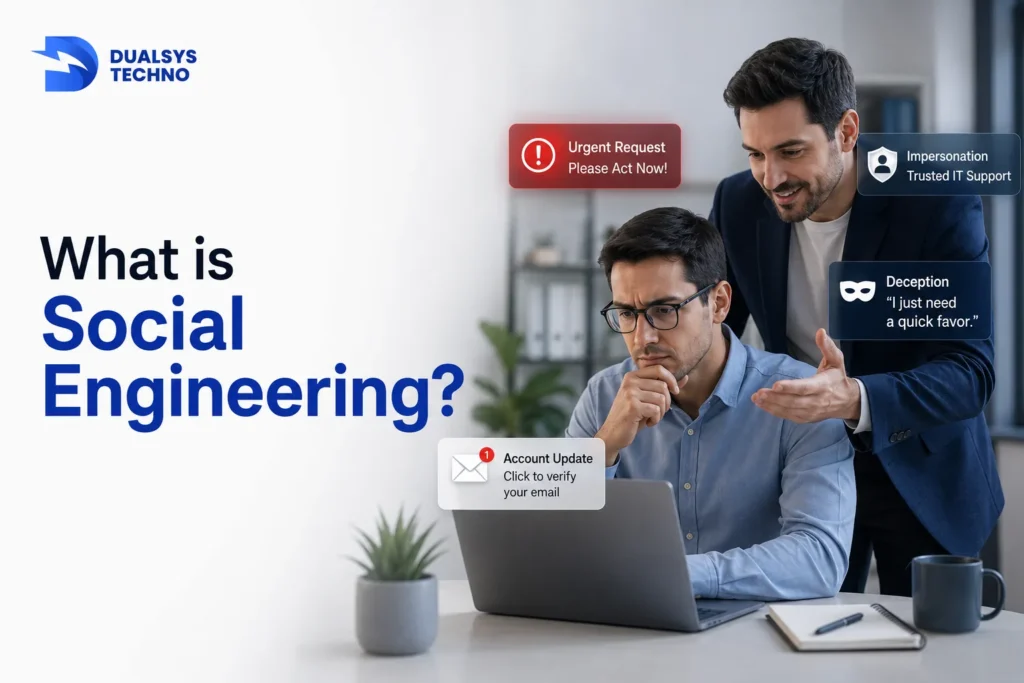
Picture this: you’re sent a message from your bank requesting verification on your account, a phone call from a manager, or an email alert saying your bank account is going to be suspended if you don’t do this ASAP. The situation might look authentic, but it’s a setup that could be carefully planned by an attacker that induces a security blunder.
This is social engineering, a cyberattack techniques aimed at people rather than just technology. The goal of an attack is to use trust, fear, urgency, curiosity, or authority to get someone to divulge sensitive information, click a malicious link, transfer money, or provide access to something without their consent.
Social engineering is a key component of knowing how to deal with increasingly sophisticated cyber attacks. In this blog post, let’s understand the methods behind these attacks, some of the more common methods, and what you can do to protect yourself.
What Is Social Engineering In Cyber Security
Social engineering is a type of cyber attack that exploits human behavior, not just technical weaknesses. Rather than directly attacking a system, attackers exploit the actions of people to create an opening for their attack. They might pose as an employee, bank representative, IT professional, or other trusted individual to make their request look legitimate.
What is interesting is that such attacks usually use psychological motivators like urgency, authority, fear, curiosity, or trust. A victim may reveal a password, divulge confidential information, click on a malicious link, wire money, or grant access without realizing it is being used to manipulate them.
This is a difference from many conventional cyber attacks, where the attacker doesn’t have to break the security system in order to gain access, but can simply trick a valid user into doing it themselves.
Types of Social Engineering Attacks
Social engineering attacks can be conducted in any number of ways. The attackers continually adjust their plans to fit the target and the information they desire and the means by which they can gain a measure of the victim’s trust. The attack can be sent through an email, a phone call, a text message, a social media interaction, or even a face-to-face conversation.
Some of the most common types of social engineering attacks include:
1. Phishing
Phishing is a fraudulent email, website, or message that appears to be from a trustworthy person or organization. The attacker could attempt to obtain login information, financial information, or other important information.
2. Spear Phishing
Spear phishing is much more targeted than a typical phishing attack. The attacker conducts an in-depth study of a person or organization and sends a personalized message that is likely to be more convincing and get the recipient’s attention.
3. Vishing
Vishing (voice phishing) is a form of phishing that uses voice communication or phone calls to deceive victims. The attacker can be a representative from a bank, customer support, government, or a company.
4. Smishing
Smishing – Phishing via SMS or Text Messages. A message could say a package is overdue, that an account needs verification, or that payment is due ASAP, leading to a malicious link or request.
5. Pretexting
Pretexting involves the hacker building a fake story or identifying himself to make the request seem real. They may pretend to be an employee, service provider, researcher, or authority figure to try to get confidential information.
6. Baiting
Baiting takes advantage of curiosity and/or the hope for a valuable item. This “bait” may be a tempting download, a freebie, a physical item, or some other promising deal that eventually takes the victim to the security threat.
7. Quid Pro Quo
In this situation, the attacker provides something in return for the information or access. For instance, they could pretend to be technical support personnel or another type of helpful service to seek information from the victim or have him or her do something for them.
8. Tailgating
Not all social engineering attacks are internet-based. Tailgating describes any physical intrusion into an area that is under protection by exploiting normal social behavior, such as following another authorized individual through a secured entrance.
How Does Social Engineering Work?
The idea behind social engineering is to take advantage of the most unpredictable factor in cybersecurity – human decision making. Attackers do not depend on technical exploits but rather attempt to manipulate an individual into making a decision that provides information, access or the ability to cause harm.
Social engineering attacks usually take several steps, each of which makes the next plausible.
1. Gathering Information
Information collection is one of the initial steps in the process. An attacker might search for information that is easily found, like a person’s name, role, place of work, email address, social media, or professional associates. Any information – no matter how insignificant – can be used to make the attacker’s approach more convincing.
2. Building Trust
After knowing what they want to accomplish, attackers develop a plausible identity, message, or situation. They can be pretending to be a colleague, customer-support person, bank officer, manager or someone else that they trust.
The idea is straightforward: leave the interaction as normal as possible, so the target doesn’t immediately suspect it.
3. Creating Psychological Pressure
Trust does not always equal trust. Some of the most common psychological triggers for attacks are urgency, fear, authority, curiosity, or reward. The message could be a threat to suspend an account, which might spur someone to act without taking time to verify the request.
4. Encouraging an Action
Once the proper setup is in place, the attacker tries to prompt the victim to perform a certain actions. This might involve clicking a link, opening an attachment, revealing sensitive information, giving a verification code, transferring money or granting access to an account or system.
5. Exploiting the Opportunity
The last step is when the manipulation is turned into a real security incident. The information or access gained can then be used to perpetrate identity theft, financial fraud, account compromise, data theft or additional attacks within an organization.
Social Engineering is basically about knowing who you’re sending the message to, building a rapport, influencing their decision, then taking advantage of the action they take in pursuit of your objective. This is the human part which makes these attacks hard to detect, and hence cybersecurity awareness is as critical as technical security measures.
How to Recognize Social Engineering Attacks
A social engineering attack can be difficult to detect – sometimes because it’s not actually that dangerous after all, more often because it’s not that obvious of a red flag. The attackers make the message, call, or request appear familiar, in order to make the target feel comfortable in responding.
The most obvious indicator is when a homeowner suddenly feels an urgent need to replace their roof.Unexpected urgency is another of the most significant warning signs. Those for urgent action, with potential consequences or pressure for a quick decision should be given special attention. Urgency is frequently used as a tool by attackers, as people tend to not focus on the details when they are in a rush.
One other key one is a peculiar request from a known person or organisation. If a co-worker suddenly requests confidential information, a company requests an unusual payment or someone asks you to circumvent a normal process, check it out separately before complying.
Also, be wary of any unexpected links, attachments, login requests, or requests for passwords and/or verification codes. Just because the message appears to be from a professional outfit doesn’t mean the sender or site is.
Lastly, listen to yourself. Pause before responding to an e-mail message if you feel panicked, unusually curious, pressured or tempted by a reward.
How to protect against social engineering attacks
Some cybersecurity tools are not necessary to protect yourself from social engineering. Sometimes, a little precaution at the right time can avert the attack. Awareness is one of the best defenses against such attacks as these depend on manipulation of people.
The following are a few simple practices that can make a difference:
- Think Before You Click
Be cautious of messages that appear familiar, but are not. Look at the site to which the link goes and think about if you really needed the message. - Verify Before You Trust
If a request for sensitive information, money or access is made, verify this independently. Contact, for instance, the person over a known phone number, instead of in answer to the message. - Keep Passwords Private
Don’t provide login information, OTPs, Recovery codes, or any other authentication information to anyone who has asked for it. If they do require it, it is not a legitimate support team. - Don’t Let Urgency Make the Decision
“Do it now” is a request that should not be taken for granted. Before acting, review the sender, the request and the details. - Limit What You Share Online
When a large amount of information is made public, it can make it easier for attackers to devise more convincing scams. Do not post unnecessary personal, professional or sensitive information on the Internet. - Keep Security Measures Updated
Keep devices and applications up to date, use strong passwords and if available multi factor authentication. These measures will help to minimize the harm even if you are being manipulated.
Why is social engineering such a successful form of cyberattack
One reason why social engineering is so effective is it relies on human behavior, and technology cannot always protect against social engineering. People are inclined to follow-known names and listen to authority, to act promptly during crises, and to investigate unusual events. These behaviours are intentionally used by the attacker to make the requests appear valid.
The other is that social engineering attacks can be pretty low-tech. An attacker can take advantage of an authorized individual instead of the security systems if that individual will give out information or access. These attacks can also be very targeted in nature, and difficult to detect. Many of the time, the attacker does not intend to break the technology, but rather to impact the person operating the technology.
Stay Safe with Dualsys Technology
The threats in the cyber world are constantly changing, but knowing what to do and how will help keep you protected. We are cyber security services company and we at Dualsys Technologies feel that cyber security begins with awareness. Continue to educate, be vigilant, and use safe digital practices to help keep your personal and business information safe.
Conclusion
Social engineering demonstrates that cybersecurity is not just about systems, but it’s about people. The attackers can leverage on trust, urgency, fear and curiosity to get normal users to take risky action. These attacks are still getting more and more convincing, but there are some easy steps to take to minimize the chances. Being vigilant, questioning strange requests, checking information yourself and keeping sensitive information safe are crucial to more secure digital interactions.
Finally, this is one of the best thing of defence against social engineering: awareness. As we gain more insight into the manipulative techniques, the more likely we are to identify them as suspicious or manipulative and to prevent them from turning into a security incident.
FAQs
Social engineering is a type of cyberattack that manipulates people into revealing sensitive information, providing unauthorized access, or performing an action that benefits an attacker. Instead of directly exploiting a technical weakness, attackers exploit human behaviour such as trust, fear, urgency, or curiosity.
Four common types are phishing, pretexting, baiting, and quid pro quo. Phishing uses deceptive messages, pretexting relies on a fabricated identity or situation, baiting uses an attractive offer or item to lure victims, and quid pro quo offers a supposed benefit or service in exchange for information or access.
Social engineering is the broader concept, covering different techniques used to manipulate people. Phishing is one specific type of social engineering that typically uses fraudulent emails, messages, or websites to trick people into revealing information or taking an unsafe action. In simple terms, phishing is a method; social engineering is the larger category.