
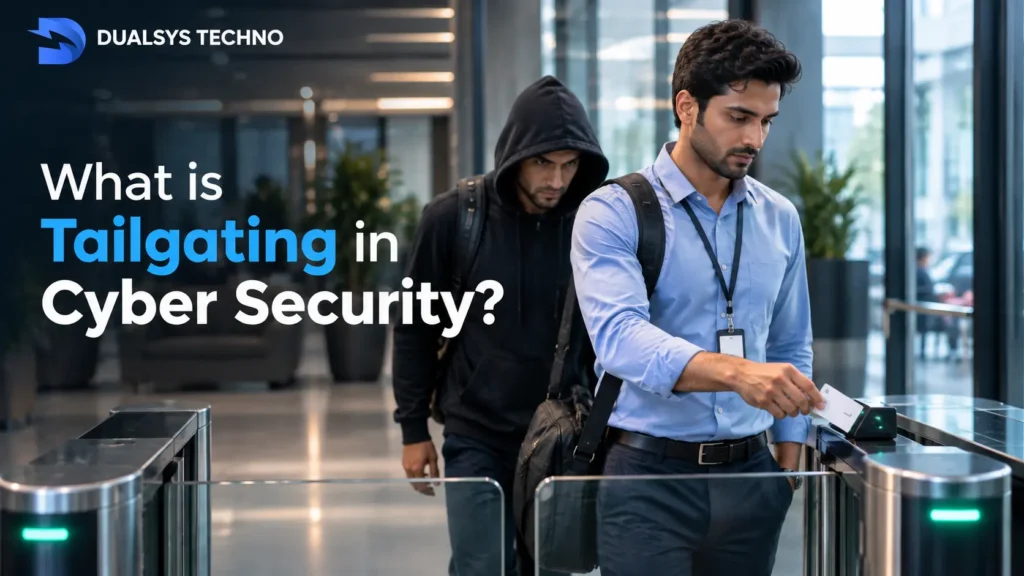
Suppose a person walks into your office directly after you without an access card, password, or security system. All they do is wait until you open the door and walk in. Sounds simple, right? In cybersecurity, it is referred to as ‘tailgating’ and can be a serious security threat.
Tailgating is a type of physical security breach in which an unauthorized person passes through a secured entrance following an authorized person. Tailgating is not a cyberattack against software, networks, or devices, but rather an attack on trust, everyday behaviour, and routine.
In this blog post, we will discuss what tailgating is and how it works, look at some examples of tailgating, the risks associated with it, how it differs from piggybacking, and how organizations can prevent it.
How Does a Tailgating Attack Work?
Tailgating attacks typically require a combination of observation, timing, human behavior, and unauthorized access. The attacker does not have to break a technical security system; it is merely a matter of gaining access in a way that is not technically secure.
Reconnaissance and Observation
The first step in an attack is to analyze the target environment. They might notice entry points, security protocols, employee habits, peak times, and less restrictive access areas. This will help them to pick the right opportunity.
Identifying an Access Opportunity
The attacker then attempts to find a time when an authorized person is gaining access to a restricted area of restriction. The aim is to gain access to that person’s legitimate credentials and take advantage of it to circumvent the usual verification process.
Exploiting Human Behavior
This is the social aspect of tailgating. Other people could be challenged for lack of trust, politeness, habit, urgency, or hesitation. It’s usually not the technology that’s the problem; it’s the way it’s being used.
Gaining Unauthorized Access
When the chance is right, the attacker approaches/enters the restricted area without providing all the required authentication. The actual user may already have been authorized, and it may not be noticed that the unauthorized entry has been made.
Moving Beyond the Initial Access
The initial goal is frequently to enter, and that’s it. The attacker can then monitor the environment for assets of value, gain access to devices that are not being attended to, or access sensitive information, or search for additional ways to enter the organization.
Using the Access for Further Attacks
Once an attacker can access systems, devices, or sensitive resources, the physical breach can become the catalyst for a larger attack. This may result in data theft, device compromise, malware installation, or disruption of critical systems, depending on what they access.
Why Tailgating Is a Serious Threat to Organizations
Tailgating can be a low-tech attack, but it is not a low-risk attack. Unauthorized access by an individual to a restricted area may result in the loss of control of the organization of who sees, accesses, alters, or removes physical and digital assets. The hazard increases if vulnerable systems, devices, documents, or network infrastructure are in the same environment.
Exposure of Sensitive Information
Inadvertent physical access may offer the opportunity to view, copy, or remove sensitive business information, customer data, intellectual property, financial records, and other information.
Compromise of Devices and Systems
An intruder can access any unprotected or unattended equipment and may be able to use it to get onto internal systems. Physical access may also provide opportunities to link up unauthorized hardware or compromise IT infrastructure.
Theft or Tampering With Company Assets
Once an intruder has gained access to a sensitive area, laptops, storage devices, networking equipment, documents, and other valuable items can be stolen, damaged, or deliberately tampered with.
A Starting Point for Larger Cyberattacks
Often physical access is the first stage in a larger security incident. An attacker can leverage the information or access gained within the organization to further compromise systems, such as installing malware, exploiting credentials, or spreading deeper into networked systems.
Operational and Financial Impact
An effective breach can cause business impacts, investigation and recovery costs, data loss, regulatory risks, and loss of customer confidence. The effects depend on the actions of the attacker upon gaining access to the system, and on what the attacker can access.
Weakening of the Organization’s Overall Security
Tailgating also exposes a difference between an organization’s technical security and physical security. An organization is only as secure as the ability of an outsider to access the systems or information it wants to secure by means other than the designed firewalls and cybersecurity tools.
Cybersecurity is becoming increasingly important as businesses face evolving digital threats and more connected systems in 2026. To understand the basics and why cybersecurity matters today, you can read our detailed guide: What Is Cybersecurity and Why Is It Important in 2026?
What is Tailgating vs. Piggybacking?
Tailgating and piggybacking are closely related physical security methods that are based on the concept of gaining access to a restricted area by using an authorized person. The only thing that differs is the way in which the unauthorized entry occurs. In a normal tailgating scenario, the intruder enters behind an authorized person, but the latter does not know that he or she is not authorized to enter. In most cases, there is a degree of awareness or cooperation from the authorized person who may be aware that someone else is piggybacking.
But not all cybersecurity sources are consistent with regard to these terms. Tailgating and piggybacking are sometimes considered synonymous with each other in the context of physical social engineering attacks. Either way, it is not a technical weakness that’s being exploited but rather an unskilled human interaction that is being used to circumvent the normal access mechanisms.
Methods of Tailgating Attacks
There is no single tailgating attack method. Depending on the environment, the security procedures being used, and people’s reaction to unexpected situations, attackers can use different approaches. Most of the techniques are based on the concept of bypassing normal access verification without actually defeating the security technology.
Social Pressure and Courtesy
The most usual method is to make it impossible for an employee to say no. The attacker can use urgency, politeness, familiarity or social pressure to bypass the need to check for permission to access the source. Humans are thus a significant component of the attack surface.
Impersonation and False Identity
An attacker can easily establish a believable identity or role to appear as someone who is or should be there. This may include impersonating as a contractor, technician, employee or trusted person. The goal is to make it look like someone is doing what they’re supposed to be doing, not what they shouldn’t be doing.
Exploiting Access-Control Gaps
Often, convincing someone doesn’t have to be part of tailgating. Opportunities for attackers include access points where access is not always monitored, entry points where access is monitored inconsistently, or doors which are left open. These gaps may let someone in without the appropriate security checks.
Interfacing with Normal Activity
The other approach is to not be noticed once you are in a sensitive area. The attacker might try to look like they belong there, so that employees or security guards won’t suspect anything. Therefore, situational awareness is an important aspect of physical security.
Exploiting overcrowded or overcrowded situations
During busy times, there can be more opportunities for unauthorized entry, as staff and security guards may not be able to keep track of everyone entering an area. This lack of attention and the increased activity near access points are opportunities for attackers.
10 ways to prevent tailgating attacks
Tailgating prevention goes beyond just closing an entrance. A blend of robust access control systems, employee awareness, visitor management, monitoring, and clearly defined security protocols are essential for organizations. Below are 10 practical steps that can help to lower the risk:
1. Strengthen Physical Access Controls
Implement proper access-control measures to allow only authorized persons to enter sensitive areas. Access should be by verified identity and permission, not just by allowing physical access.
2. Use Anti-Tailgating Technology
For high-security areas, mantraps, turnstiles, anti-tailgating doors and sensors help to detect or prevent more than one person trying to enter through a controlled access point.
3. Establish a Clear “No Unauthorized Entry” Policy
All employees should be aware that access rules apply to all. A person who is not authorized should be directed through the proper verification process within the organization, and not be granted access to a restricted area.
4. Train Employees Regularly
Security awareness training should cover what tailgating is, the importance of it and what to do about it. NIST recommends security learning programs that lead to change and a more resilient security culture.
5. Create a Safe Challenge-and-Report Culture
Staff should challenge or report any suspicious access without causing confrontation. Concerns should be reported to security or management through an avenue that is clearly defined in the organization.
6. Control and Monitor Visitors
Access to the site should be given with proper authentication and movement restricted as per the organization’s policy. In sensitive environments, visitors may require escort or constant supervision. CISA recommends that visitor access be authenticated, and escorts and monitors be used where applicable to monitor visitor activity.
7. Secure Restricted Areas Separately
Not all areas in a workplace require the same access. If specific areas are in need of access, such as those with sensitive information, critical infrastructure, or important IT equipment, they should be provided with extra access restrictions based on their risk level.
8. Monitor Physical Access
Organizations can use CCTV, access logs, alarms, and security staff to detect abnormal activity and investigate potential breaches. CISA recommends that physical access be monitored and access logs be reviewed as part of the security and incident-response process.
9. Review Access Permissions Regularly
Access shouldn’t be active for a lifetime. Organizations should regularly audit who has access and revoke or adjust access as roles change, staff members leave the organization, or no longer need access.
10. Test and Improve Security Procedures
Security controls should be periodically reviewed and tested to uncover gaps in security, such as inadequately monitored entrances, ineffective procedures, or employee awareness problems. After incidents and security assessments are conducted, their lessons should be applied to enhance the security of the organization as a whole.
Strengthen Your Security with Dualsys Technology
Protect your business from evolving cybersecurity threats with Dualsys Technology. Our expert team helps organizations strengthen security, identify vulnerabilities, and protect critical systems and data with reliable, business-focused cybersecurity solutions. Connect with us today.
Conclusion
Tailgating might seem like a trivial physical security problem, but it can pose significant cyber security threats to an organization. Unauthorized access can expose sensitive information, devices, infrastructure, and connected systems to potential threats. It can’t be contained with access control alone; employee awareness, visitor management, monitoring, definite security policies and frequent access reviews are just as critical.
With the connections that businesses are making, physical and digital security need to go hand-in-hand. By implementing a multi-layered security strategy, organizations can minimize vulnerabilities and be more effective in mitigating potential threats. Companies aiming to enhance their security strategies can benefit from Cyber Security Services in India, which offer the necessary expertise and solutions to safeguard critical systems, data, and operations.
FAQs
What Are Common Tailgating Methods?
Common tailgating methods include following an authorized person through a secured entrance, pretending to be an employee or service worker, taking advantage of an open door, or using social pressure to avoid being questioned.
What is an Example of Tailgating?
For example, an unauthorized person may enter an office by closely following an employee through a secured door after the employee uses their access card. The person gets inside without using their own credentials.
What is Tailgating vs. Piggybacking?
Tailgating and piggybacking are similar physical security techniques. Tailgating generally occurs when someone follows an authorized person without their knowledge, while piggybacking usually involves the authorized person knowingly allowing them to enter.
What are the top 3 types of cyber attacks?
Three common types of cyber attacks are phishing, malware, and ransomware. Phishing tricks users into sharing information or taking unsafe actions, while malware and ransomware can compromise systems, files, and sensitive data.